IVF in the UK: More Patients, New Technology and Why Equity Still Matters
IVF has helped more people than ever start or grow their families, and the latest figures from the Human Fertilisation and Embryology Authority (HFEA) make that unmistakably clear.
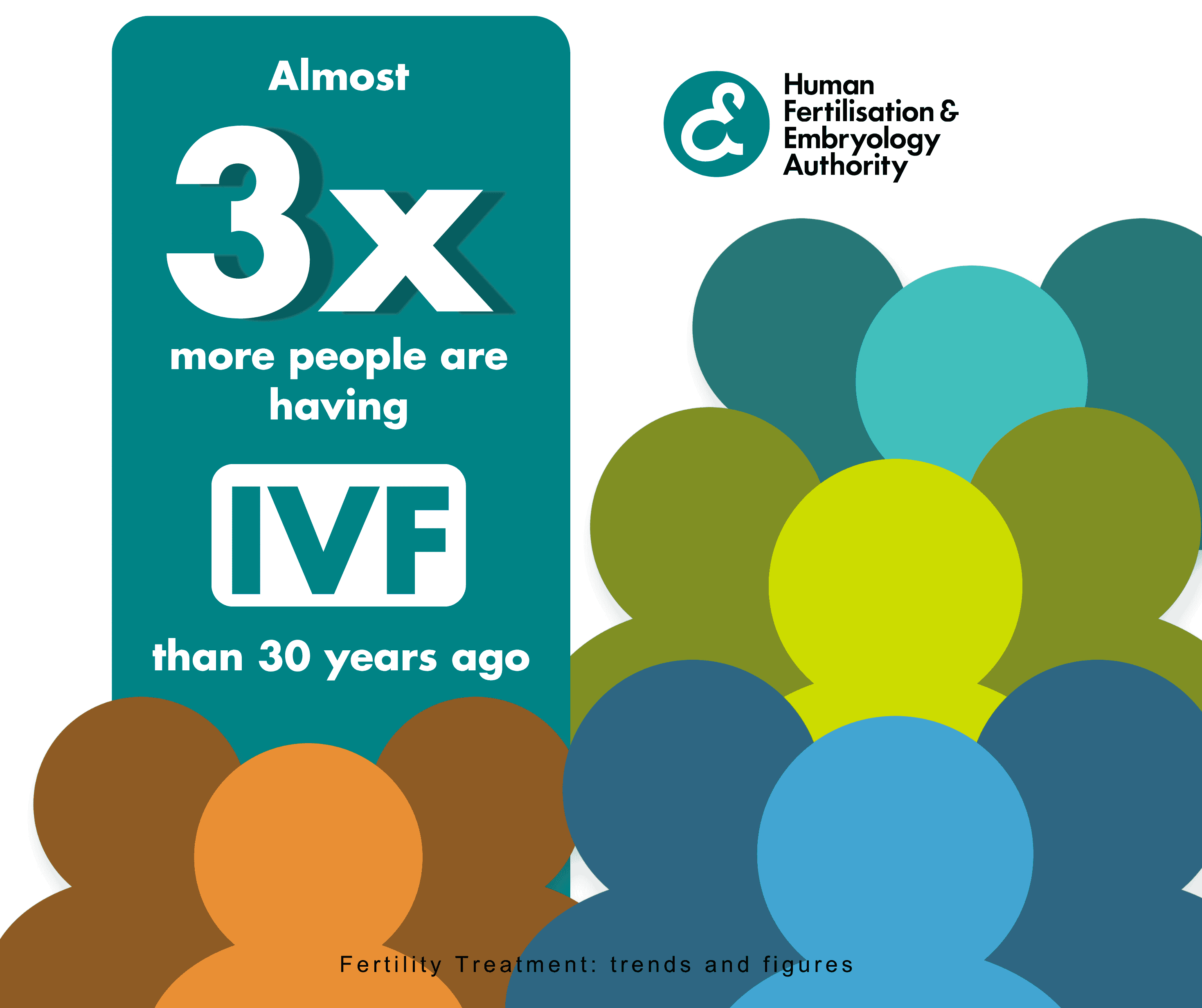
Patient numbers have almost tripled over the last 30 years, rising from around 19,000 in the early 1990s to 53,000 in 2024. In 2024 alone, around 21,000 IVF babies were born, meaning IVF now accounts for over 3% of all UK births (roughly 1 in 31).
That’s progress worth recognising. But as Debbie Evans, our Chief Quality and Compliance Officer, points out: the story isn’t only about growth. It’s also about outcomes, equity, and the uncomfortable reality that success rates haven’t risen as much as many people assume.
The headline growth: IVF is now part of everyday family-building
The HFEA data shows IVF is no longer a niche treatment. It’s part of the fabric of modern family-building in the UK.
Key trends include:
- IVF births have doubled as a proportion of all UK births, from less than 1.5% in 2004 to over 3% in 2024.
- Most IVF births (81%) are from treatment using a patient’s own eggs and partner sperm.
- Around 1 in 5 IVF births involve donor eggs, sperm, embryos, or donor insemination – accounting for roughly 1 in 137 of all UK births in 2024.
For intended parents, surrogates, and donors alike, this matters: it reflects a society where more routes to parenthood are being used, and, increasingly, needed.
The part that stops you in your tracks: success rates are still only 30%
With the pace of scientific advancement, genetic testing, improved lab techniques, better culture conditions, many people expect IVF success rates to have climbed dramatically.
But the average IVF birth rate per embryo transferred in 2024 was still only 30%.
Yes, outcomes are stronger for younger patients:
- Ages 18 to 34: 38% birth rate per embryo transferred
- Ages 43 to 44: 8% birth rate per embryo transferred
Debbie’s perspective is grounded in decades of lived professional experience in fertility care:
Thirty years ago, clinics often quoted success rates of around 15–25%, before blastocyst culture became standard, and at a time when embryos were commonly transferred on day 2 or 3. Freezing was far less routine.
So, while IVF has evolved enormously, the overall “headline” success rate still has a stubborn ceiling, and that’s a reality patients deserve to understand with clarity and compassion.
A note for intended parents considering surrogacy:
It’s also worth saying clearly that these national “headline” IVF success rates don’t always translate directly to surrogacy pathways. In many surrogacy programmes, the person carrying the pregnancy is not experiencing infertility and has no uterine-factor barrier to implantation, and surrogates are typically screened carefully for health and obstetric history. In some cases, embryos transferred may also be selected using additional tools such as genetic testing. That combination can mean outcomes in surrogacy programmes may look stronger than the national average — but it doesn’t remove the underlying truth of the HFEA data: success is still shaped by embryo quality, age, and the choices available to patients.
And that’s exactly why the next shift in the data matters: not just whether IVF is growing, but how it’s being practised — including the rapid rise in frozen embryo transfers.
Frozen embryo transfers: a major shift and a positive one
One of the most significant changes in IVF practice is the rise of frozen embryo transfers.
In 2024, frozen embryo transfers accounted for almost half (48%) of all IVF cycles.
This is genuinely encouraging. Frozen transfers can support safer, more flexible treatment planning, and in many cases, outcomes with frozen transfers are more positive.
The growth in freezing also shows up in the wider data:
- Egg and embryo freezing cycles made up 17% of all cycles in 2024.
- Most of these were embryo freezing cycles.
Behind these numbers are real people making careful decisions: preserving fertility, spacing treatment, protecting health, and giving themselves more than one chance at the outcome they’re hoping for.
Safer outcomes: multiple births have fallen sharply
Another meaningful improvement is the reduction in multiple births.
Multiple births have dropped from 14% in 2014 to 3.2% in 2024.
This reflects better clinical decision-making and a stronger focus on single embryo transfer where appropriate, reducing risks for both babies and the person carrying the pregnancy.
For families considering surrogacy, this is especially important: safety must sit at the centre of any pathway, and the wider fertility sector is clearly moving in the right direction here.
The equity gap: outcomes still differ by ethnicity
The most worrying finding in the HFEA report is that disparities in outcomes persist.
Black and Asian patients aged 18 to 37 continue to have lower IVF birth rates than White and Mixed ethnic backgrounds.
- White patients: 36% birth rate per embryo transferred
- Black and Asian patients: 30% birth rate per embryo transferred
The data also highlights differences in when people start treatment:
- For Black patients, the average age at treatment has decreased by around a year from 2019 to 2024, but disparities remain.
- Black patients are still starting IVF almost a year later than Asian and White patients.
- Patients from Mixed ethnic backgrounds are starting treatment later too, increasing from 35 in 2019 to 36 in 2024.
These aren’t just statistics. They represent unequal chances at something profoundly human: the chance to build a family.
At MSJ, we believe ethical family-building must also be equitable family-building. If access, outcomes, and support are not fair then the system is not yet good enough.
Access is tightening: fewer NHS-funded cycles
The report also points to a decline in NHS-funded IVF cycles.
Across the UK, the proportion of NHS-funded IVF cycles fell from 35% in 2019 to 28% in 2024, and was lowest in England at 25%.
When almost three quarters of patients are paying for treatment themselves, the pressure is not only financial. It’s emotional. It can shape timelines, choices, and the ability to keep going after a setback.
This is why transparency matters, and why the sector must keep pushing for fair access.
Looking ahead: we want surrogacy reflected in the national picture
We work in an incredibly fast-evolving medical industry. And yet one part of modern family-building is still too often missing from the national conversation: surrogacy.
We hope to see surrogacy figures included in future HFEA reporting. Not because surrogacy is “niche,” but because it’s a vital pathway for many families, and the outcomes, experiences, and safeguards in surrogacy deserve the same visibility, scrutiny, and commitment to improvement.
Our takeaway
The HFEA’s 2024 trends show a fertility sector that has grown dramatically and improved in important ways, especially in the rise of frozen transfers and the reduction of multiple births.
But the data also asks us to be honest:
- Success rates are still limited.
- Outcomes are not equal across ethnicities.
- Access is becoming harder for many.
At My Surrogacy Journey, we’ll keep advocating for safe, ethical, regulated family-building, and for a system that treats every patient and every family with the fairness, dignity, and care they deserve.
If you’re navigating IVF, donor conception, or surrogacy and want support that’s grounded in experience and led with compassion, we’re here.